RedKalion
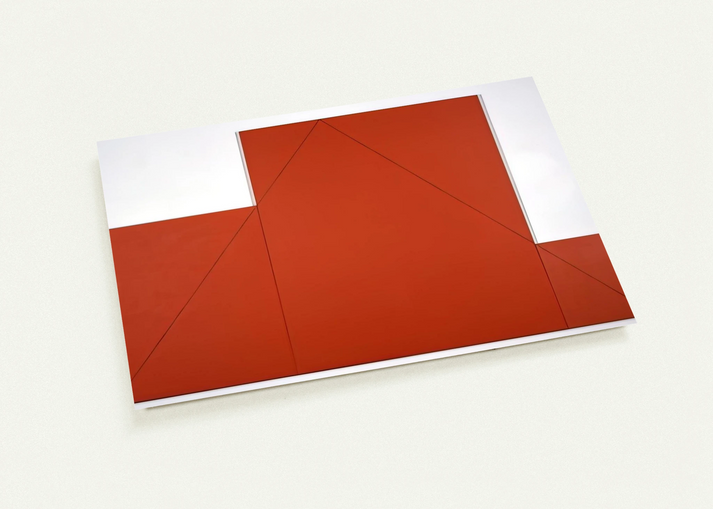
A TRIANGLE WITHIN THREE RECTANGLES 1977 By Robert Mangold Pack of 10 Post Cards | Robert Mangold Post Cards | A6 (10.5 x 14.8 cm) - 4.1 x 5.8 inches
A TRIANGLE WITHIN THREE RECTANGLES 1977 By Robert Mangold Pack of 10 Post Cards | Robert Mangold Post Cards | A6 (10.5 x 14.8 cm) - 4.1 x 5.8 inches
Couldn't load pickup availability
Elevate Your Correspondence with Minimalist Mastery
Robert Mangold's 1977 masterpiece, 'A Triangle Within Three Rectangles', is a profound exploration of geometric logic and spatial harmony. This pack of 10 museum-quality postcards brings the rigorous intellectualism of American Minimalism into the palm of your hand. Mangold, a central figure in the movement, is renowned for challenging the traditional canvas shape, and this work exemplifies his ability to create tension between internal linear elements and the surrounding architectural frame.
Museum-Grade Reproduction and Technical Excellence
At RedKalion, we believe fine art should be accessible without compromising on integrity. Each postcard is produced using 12-color fine art printing technology. Unlike standard 4-color inkjet processes, our method ensures that the subtle shifts in tone and the precise, architectural lines of Mangold’s work are captured with stunning depth and chromatic accuracy. The smooth matte finish eliminates glare, allowing the viewer to appreciate the interplay of the triangle and rectangles just as the artist intended.
- Historical Significance: Part of Mangold's critical 1970s period exploring the 'Frame' and 'Shape' series.
- Archival Quality: Printed on 200 gsm (80 lb) FSC-certified paper for durability and a premium feel.
- Precise Dimensions: Standard A6 size (10.5 x 14.8 cm), perfect for framing or high-end correspondence.
- Eco-Conscious Curation: Responsibly sourced materials that honor the legacy of the art and the environment.
Whether used for a thoughtful message or displayed as a curated set of miniature prints, these postcards serve as a testament to the enduring power of geometric abstraction. Experience the archival quality of a RedKalion reproduction and share a piece of art history that endures.

Discover Unlimited Art Possibilities
At RedKalion, you can find virtually any artwork from any artist, available in a wide range of sizes to perfectly match your space.
If you didn’t find what you’re looking for, contact us at support@redkalion.com . We will source any artwork and produce it in any size and format you need, including art prints, posters, canvas, framed pieces, framed canvas, and more.
For dedicated art enthusiasts, we also offer handcrafted replicas of any artwork, carefully painted by highly skilled artists using traditional techniques.
For custom requests, contact us at support@redkalion.com .
What printing technology is used for these Robert Mangold postcards?
We utilize advanced 12-color fine art printing technology. This provides superior color vibrancy and accuracy compared to standard 4-color printing, ensuring every nuance of the original 1977 artwork is preserved.
What is the paper quality and weight of this postcard set?
These postcards are printed on premium 200 gsm (80 lb) paper with a thickness of 0.26 mm. The smooth matte finish provides a clean, glare-free aesthetic suitable for both writing and display.
Are these art postcards environmentally friendly?
Yes. RedKalion is committed to sustainability; these postcards are printed on FSC-certified paper, ensuring the materials are sourced from responsibly managed forests that provide environmental and social benefits.
How are the Robert Mangold postcards shipped to ensure safety?
Our postcards are packaged with care to prevent bending or moisture damage during transit. We print on demand to maintain quality control and ensure your set arrives in pristine museum-grade condition.
Will the colors of 'A Triangle Within Three Rectangles' fade over time?
No. By using archival-grade inks and high-quality matte paper, our prints are designed for longevity. The 12-color process is specifically engineered to resist fading and maintain depth for decades.
What is the significance of the geometric forms in Robert Mangold's 1977 work?
Mangold used these forms to explore the relationship between the edge of the paper and the internal drawing. The triangle and rectangles create a dialogue about balance, symmetry, and the definition of space.
How does Mangold's use of a matte finish influence the viewer's perception?
The matte finish reflects Mangold's own preference for non-reflective surfaces, which emphasizes the flat, architectural nature of the work and forces the viewer to focus on the purity of line and color.