RedKalion
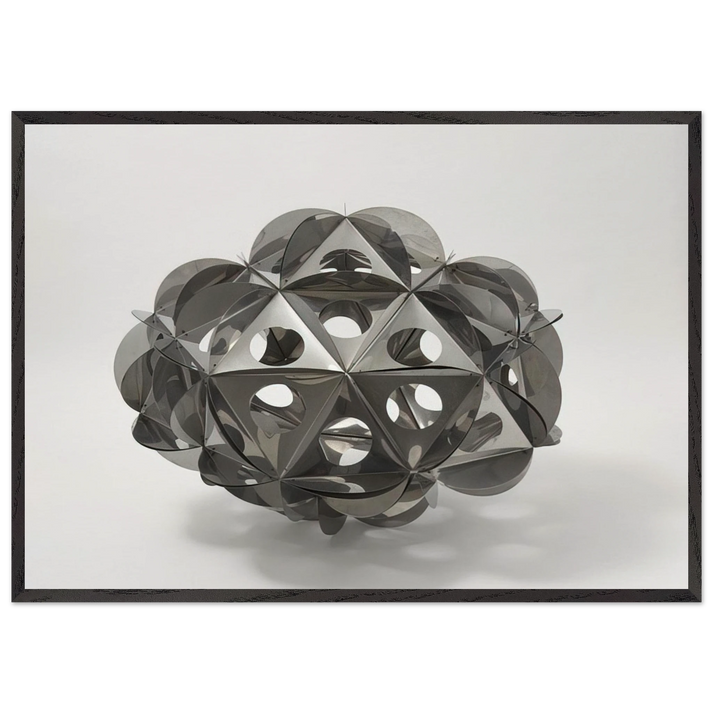
Acona Biconbi - 1965 - Bruno Munari 70x100 cm / 28x40 inches Framed Art Print – Black Wooden Frame
Acona Biconbi - 1965 - Bruno Munari 70x100 cm / 28x40 inches Framed Art Print – Black Wooden Frame
Couldn't load pickup availability
Elevate Your Space with Bruno Munari’s Geometric Masterpiece
Immerse yourself in the world of 20th-century Italian modernism with this museum-quality reproduction of Acona Biconbi (1965) by Bruno Munari. This iconic work represents the pinnacle of Munari’s research into geometric modules and the perception of space. The 'Acona Biconbi' series serves as a profound exploration of concave and convex forms, where simple circles are transformed into dynamic, three-dimensional rhythmic compositions. This 70x100 cm / 28x40 inches framed art print captures the original’s intellectual rigor and playful spirit, making it a definitive statement piece for any sophisticated interior.
The RedKalion Archival Standard
At RedKalion, we believe that world-class art deserves world-class materials. This archival-grade reproduction is printed on 250 gsm (110 lb) natural white, matte, and uncoated paper. The museum-quality thickness (0.29 mm) ensures long-lasting durability, while the matte finish eliminates distracting glare, allowing the precise geometry of Munari’s design to remain the focal point. Our commitment to sustainability is reflected in our use of FSC-certified materials, ensuring your acquisition supports responsible forestry.
Museum-Grade Framing and Finish
Your Acona Biconbi print arrives protected by high-clarity, shatterproof plexiglass and is encased in a premium 20mm (0.79") thick black wooden frame. Meticulously crafted from responsibly sourced oak and ash, the frame is wider and more robust than standard gallery frames, providing a significant presence on your wall.
- Ready-to-hang: Each order includes a pre-mounted hanging kit for immediate installation.
- Archival Longevity: Acid-free paper prevents yellowing, preserving the ink’s depth for decades.
- Expert Craftsmanship: Hand-assembled by specialists to ensure structural integrity and aesthetic perfection.
By choosing this Bruno Munari fine art print, you are not merely purchasing decor; you are investing in a piece of design history, curated by RedKalion to meet the highest standards of the global art market.

Discover Unlimited Art Possibilities
At RedKalion, you can find virtually any artwork from any artist, available in a wide range of sizes to perfectly match your space.
If you didn’t find what you’re looking for, contact us at support@redkalion.com . We will source any artwork and produce it in any size and format you need, including art prints, posters, canvas, framed pieces, framed canvas, and more.
For dedicated art enthusiasts, we also offer handcrafted replicas of any artwork, carefully painted by highly skilled artists using traditional techniques.
For custom requests, contact us at support@redkalion.com .
What is the quality of the paper used for the Acona Biconbi print?
We use 250 gsm (110 lb) natural white, archival-grade paper. It is a museum-quality, matte, and uncoated substrate with a thickness of 0.29 mm, ensuring it remains flat and maintains vibrant color depth over time without yellowing.
Is the frame included and ready to hang?
Yes, your Bruno Munari print comes in a high-quality 20mm black wooden frame made from oak and ash. It includes a complete hanging kit, allowing you to display this archival masterpiece immediately upon arrival.
How is the artwork protected during shipping and display?
To ensure maximum safety, we use shatterproof plexiglass. This provides the clarity of glass while offering superior protection against breakage and UV exposure, keeping your fine art print pristine during transit and in your home.
Is the paper used for this Bruno Munari print sustainable?
Absolutely. RedKalion is committed to environmental responsibility. We use FSC-certified paper and materials (or equivalent local standards) to ensure your artwork is as sustainable as it is beautiful.
What are the dimensions of the frame itself?
The frame features a contemporary profile that is 20mm (0.79") thick and wide. This is specifically designed to be wider and more durable than the standard 14mm gallery frames, providing a premium, high-end aesthetic.
What does the title 'Acona Biconbi' signify?
The title is a linguistic play on 'concave' and 'convex.' It reflects Bruno Munari’s 1965 exploration of how two-dimensional geometric shapes can be folded or combined to create the illusion of three-dimensional space and movement.
When did Bruno Munari create the original Acona Biconbi?
The original research for Acona Biconbi began in 1965. It was part of Munari’s broader 'Spatial' research, where he aimed to democratize art by creating modular pieces that viewers could interact with or rearrange.