
RedKalion
Alexander Calder - OBJECT WITH RED BALL 1931 Fine Art Poster
Alexander Calder - OBJECT WITH RED BALL 1931 Fine Art Poster
Couldn't load pickup availability
Alexander Calder: The Geometry of Motion in 'Object with Red Ball' (1931)
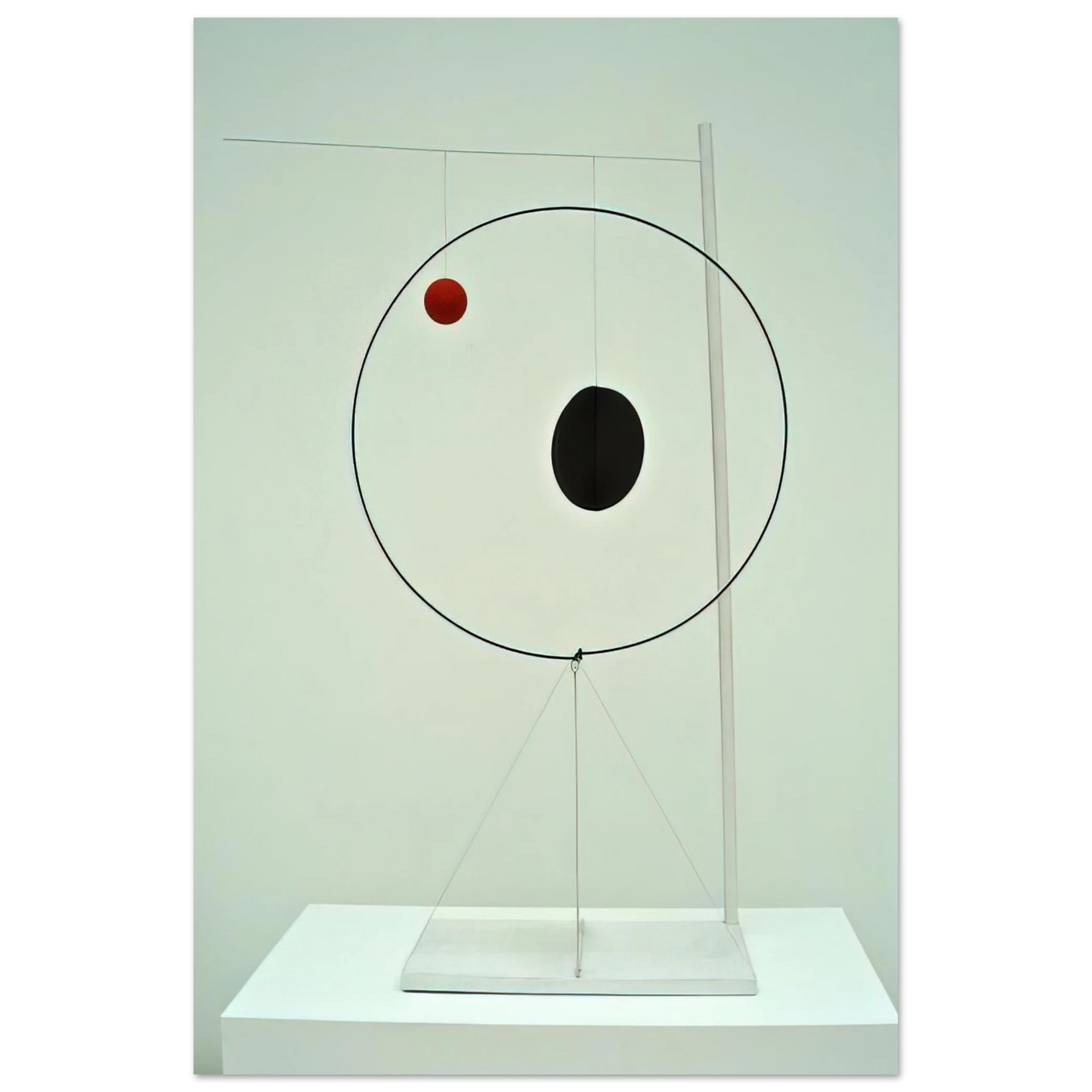
Step into the foundational era of kinetic art with our museum-quality reproduction of Alexander Calder’s 'Object with Red Ball' (1931). This seminal work represents a critical juncture in Calder’s career, marking his transition from figurative wire sculptures to the non-objective, spatial abstractions that would eventually define the modern 'mobile.' Inspired by a visit to Piet Mondrian’s studio, Calder began to explore the tension between balance, primary colors, and the void.
This fine art print captures the minimalist precision of the original, where a single vibrant red sphere anchors a delicate arrangement of geometric lines. At RedKalion, we curate these masterpieces using Master's Edition archival paper, ensuring that the stark contrast and subtle textures of Calder's early abstraction are preserved with absolute fidelity. The natural white (off-white) finish of the paper provides a luxurious, non-reflective surface that complements both modern and mid-century interiors.
Archival Integrity & Museum-Grade Specifications
Every print is produced on 250 gsm (110 lb) thickness paper, offering a heavy, premium feel that signifies its durability. Because we utilize acid-free (pH above 7) materials, your reproduction is chemically stable and resistant to yellowing, ensuring the 'Object with Red Ball' remains as striking in decades as it is today. Our commitment to excellence extends to the environment; we exclusively use FSC-certified paper, printed and shipped on demand with meticulous care.
- Artist: Alexander Calder
- Title: Object with Red Ball (1931)
- Material: 250 gsm Master's Edition Museum Paper
- Texture: Uncoated, matte, premium tactile finish
- Sustainability: FSC-certified responsibly sourced materials


Discover Unlimited Art Possibilities
At RedKalion, you can find virtually any artwork from any artist, available in a wide range of sizes to perfectly match your space.
If you didn’t find what you’re looking for, contact us at support@redkalion.com . We will source any artwork and produce it in any size and format you need, including art prints, posters, canvas, framed pieces, framed canvas, and more.
For dedicated art enthusiasts, we also offer handcrafted replicas of any artwork, carefully painted by highly skilled artists using traditional techniques.
For custom requests, contact us at support@redkalion.com .
What is the quality of the paper used for this Alexander Calder print?
We use Master's Edition archival paper, weighing 250 gsm (110 lb). This heavy, museum-quality paper provides a premium, luxurious feel and a thickness of 0.29 mm, ensuring your fine art poster is durable and resistant to warping.
Will the colors of 'Object with Red Ball' fade over time?
No. Our prints are made on acid-free paper with a pH above 7, which prevents yellowing and degradation. Combined with archival-grade inks, this ensures the vibrant red and deep blacks remain museum-constant for generations.
Is the paper used for this reproduction sustainable?
Yes, RedKalion is committed to environmental responsibility. We exclusively use FSC-certified paper (Forest Stewardship Council), which guarantees that the materials are sourced from responsibly managed forests that provide environmental, social, and economic benefits.
How is the print shipped and fulfilled?
We operate on a demand-based model with no minimum orders. Each Alexander Calder print is produced specifically for you and shipped in protective, secure packaging to ensure it arrives in pristine condition at your doorstep.
What kind of finish does the print have?
The print features a matte, uncoated finish on a natural white (off-white) base. This finish eliminates glare and reflections, allowing the viewer to appreciate the subtle textures and geometric precision of Calder's composition from any angle.
What was the significance of 1931 in Alexander Calder's career?
1931 was a pivotal year for Calder. It marked his departure from figurative work toward 'stabiles' and early motorized 'mobiles,' reflecting his fascination with the Abstraction-Création movement and his revolutionary use of spatial movement.
How does 'Object with Red Ball' reflect the Abstraction-Création movement?
This piece exemplifies the movement's focus on non-figurative, geometric purity. Calder utilizes the red ball as a focal point to create a sense of equilibrium and 'directional tension' within a three-dimensional field translated onto a two-dimensional plane.