RedKalion
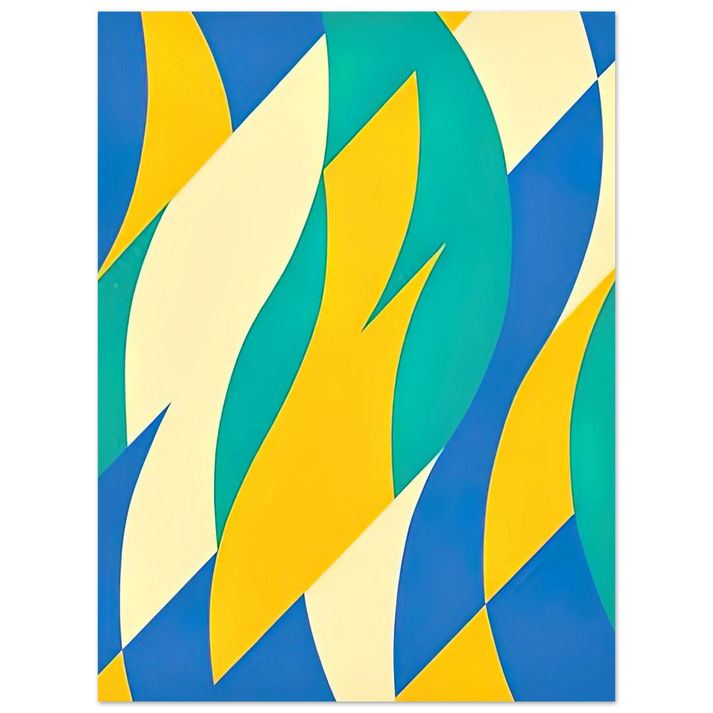
Bridget Riley - FOLD 2004 75x100 cm / 30x40inches Fine Art Poster
Bridget Riley - FOLD 2004 75x100 cm / 30x40inches Fine Art Poster
Couldn't load pickup availability
Bridget Riley – FOLD (2004): A Masterpiece of Rhythmic Precision
Experience the mesmerizing allure of Bridget Riley’s FOLD (2004), a definitive work from one of the most influential figures in contemporary abstract art. This piece represents a sophisticated evolution of the Op Art movement, where Riley moves beyond the rigid geometry of her early career into a lyrical exploration of curvilinear forms and chromatic harmony. The sweeping, intersecting arcs of FOLD create a dynamic sense of depth and movement, inviting the viewer into a rhythmic dance of perception.
As a premier curator of world-class art, RedKalion offers this museum-quality reproduction with an unwavering commitment to archival excellence. Every fine art print is meticulously produced to capture the subtle nuances and vibrant energy of Riley's original vision, ensuring the optical effects remain as potent as the day they were conceived.
To honor the precision of Riley’s technique, we utilize our Master's Edition archival paper. This premium substrate provides a sophisticated, matte, and uncoated natural white finish that avoids the glare of lesser reproductions, allowing the intricate color relationships to breathe. Designed to endure for generations, this print is the ultimate choice for the discerning collector looking to elevate their space with an archival masterpiece.
- Paper Specification: 250 gsm (110 lb) Master's Edition, museum-quality.
- Archival Integrity: Acid-free (pH above 7) to prevent yellowing or degradation over time.
- Texture & Feel: 0.29 mm (11.4 mils) thickness with a luxurious, uncoated off-white finish.
- Sustainability: Printed on FSC-certified paper, reflecting a commitment to environmental stewardship.
- Fulfillment: Expertly printed and shipped on demand with no minimum order requirements.

Discover Unlimited Art Possibilities
At RedKalion, you can find virtually any artwork from any artist, available in a wide range of sizes to perfectly match your space.
If you didn’t find what you’re looking for, contact us at support@redkalion.com . We will source any artwork and produce it in any size and format you need, including art prints, posters, canvas, framed pieces, framed canvas, and more.
For dedicated art enthusiasts, we also offer handcrafted replicas of any artwork, carefully painted by highly skilled artists using traditional techniques.
For custom requests, contact us at support@redkalion.com .
What defines the paper quality of this Bridget Riley FOLD 2004 print?
This reproduction uses Master's Edition archival paper, weighing 250 gsm (110 lb). It features a luxurious matte, uncoated, natural white finish that ensures museum-quality depth and detail for fine art collectors.
How does the archival nature of the print benefit the collector?
Our prints are acid-free with a pH level above 7, preventing the paper from yellowing or becoming brittle. This ensures your Bridget Riley fine art print maintains its vibrant color and structural integrity for decades.
What are the shipping and fulfillment logistics for this artwork?
RedKalion operates on a high-efficiency print-on-demand model with no minimum order requirements. Each museum-quality reproduction is carefully packaged and shipped globally to ensure it arrives in pristine condition.
Is the paper used for this reproduction environmentally sustainable?
Yes, we prioritize sustainability by using FSC-certified paper. This ensures that your museum-quality art print meets rigorous environmental and social standards during production.
What is the physical thickness and weight of the FOLD 2004 print?
The print features a substantial weight of 250 gsm (110 lb) and a thickness of 0.29 mm (11.4 mils), providing the tactile feel and durability expected of professional gallery displays.
What inspired the Bridget Riley 'FOLD' series?
The FOLD series reflects Riley's late-career shift toward curvilinear forms. It explores how intersecting shapes and rhythmic color patterns can create an illusion of three-dimensional depth and fluid movement on a flat surface.
Why is the 2004 period significant in Bridget Riley's career?
By 2004, Riley had mastered the use of 'arabesque' curves. This era represents a transition from her earlier linear patterns to more organic, flowing compositions that challenge the viewer's optical perception in softer, more complex ways.