RedKalion
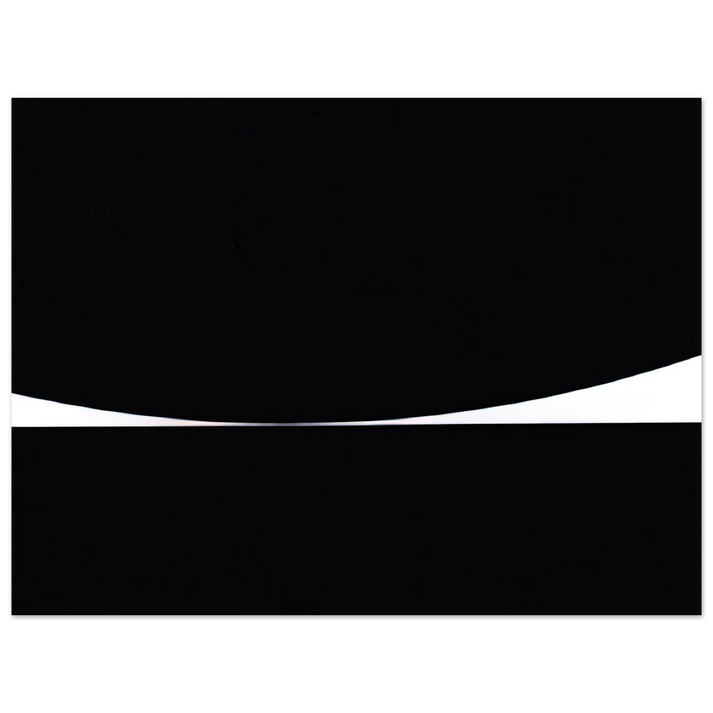
Bridget Riley - KISS 1961 75x100 cm / 30x40inches Fine Art Poster
Bridget Riley - KISS 1961 75x100 cm / 30x40inches Fine Art Poster
Couldn't load pickup availability
Elevate Your Space with Bridget Riley’s Op Art Masterpiece: Kiss (1961)
Experience the mesmerizing tension of the British Op Art movement with this museum-quality reproduction of Bridget Riley’s Kiss (1961). As one of the most significant works from Riley's early black-and-white period, Kiss explores the psychological and physiological boundary where two solid forms almost touch, creating a profound sense of compression and energy. This fine art print captures the precise geometric rigor and illusory movement that defined Riley's career and transformed modern perception.
Art Historical Significance and Technique
In 1961, Bridget Riley began a series of radical experiments that would strip art down to its essential elements: shape and contrast. In Kiss, the composition features a stark black void meeting a curved white horizon. The 'kiss' occurs at the point of near-contact, where the eye perceives a vibration of space. This work is a testament to Riley's expertise in manipulating formal elements to evoke visceral physical responses, moving the viewer beyond passive observation into an active optical experience.
Uncompromising Museum-Quality Craftsmanship
At RedKalion, we curate archival-grade reproductions that honor the integrity of the original vision. To ensure this archival masterpiece endures for generations, we utilize our Master's Edition archival paper. This 250 gsm (110 lb) natural white, off-white paper provides a luxurious, uncoated matte texture that eliminates glare, allowing the stark contrasts of Riley's work to resonate with deep, velvety blacks and crisp whites.
- Archival Longevity: Acid-free (pH above 7) to prevent yellowing or degradation over decades.
- Substantial Weight: 250 gsm thickness (0.29 mm) for a premium, gallery-standard feel.
- Sustainable Excellence: Printed on FSC-certified paper, supporting responsible forestry.
- Ready for Curation: Delivered as a sophisticated, high-contrast focal point for your collection.

Discover Unlimited Art Possibilities
At RedKalion, you can find virtually any artwork from any artist, available in a wide range of sizes to perfectly match your space.
If you didn’t find what you’re looking for, contact us at support@redkalion.com . We will source any artwork and produce it in any size and format you need, including art prints, posters, canvas, framed pieces, framed canvas, and more.
For dedicated art enthusiasts, we also offer handcrafted replicas of any artwork, carefully painted by highly skilled artists using traditional techniques.
For custom requests, contact us at support@redkalion.com .
What defines the quality of this Bridget Riley fine art print?
This print is produced on Master's Edition archival paper, weighing 250 gsm (110 lb). Its luxurious, natural white matte finish ensures museum-quality depth and detail without the glare of standard posters.
How does RedKalion ensure the longevity of the Kiss (1961) reproduction?
We use acid-free paper with a pH level above 7. This chemical stability prevents the paper from yellowing or becoming brittle, ensuring your investment remains pristine for decades.
What is the significance of Kiss (1961) in Bridget Riley's career?
Kiss (1961) marks the definitive start of Riley's black-and-white Op Art phase. It explores the 'perceptual friction' created by converging geometric shapes, a hallmark of her world-renowned style.
How is the artwork shipped and fulfilled?
RedKalion prints and ships each order on demand with no minimums. Every fine art print is handled with extreme care to ensure it arrives in perfect gallery condition.
Does this print have a matte or glossy finish?
This reproduction features a sophisticated matte, uncoated finish. This choice preserves the velvety texture of the black ink and the subtle off-white of the archival paper.
Are there sustainable practices involved in the production of this print?
Yes, we prioritize sustainability by using FSC-certified paper. This ensures that the premium materials used for your artwork come from responsibly managed forests.
Why did Bridget Riley choose a black-and-white palette for this composition?
Riley utilized black and white to maximize optical tension. By removing color, she forced the viewer to focus entirely on the structural energy and the illusion of movement between shapes.