RedKalion
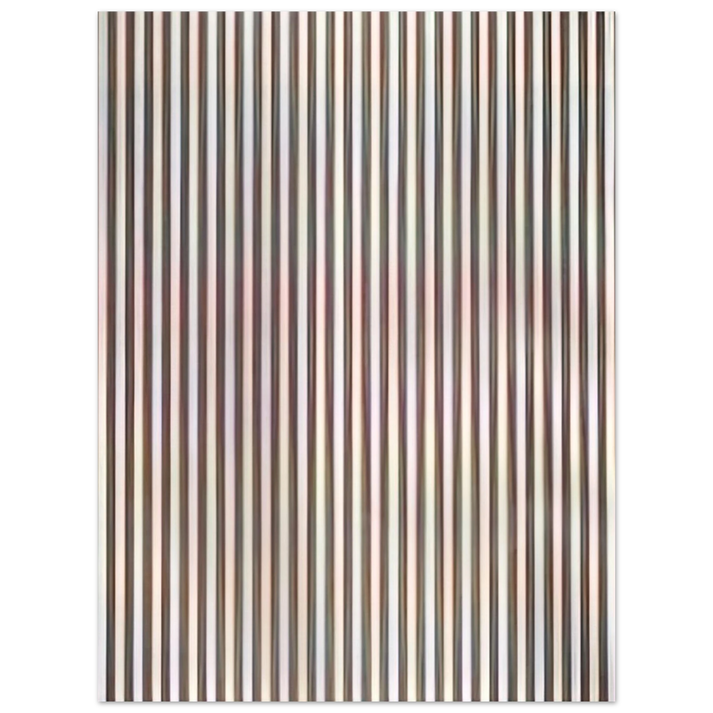
Bridget Riley - ZING 1 1971 75x100 cm / 30x40inches Fine Art Poster
Bridget Riley - ZING 1 1971 75x100 cm / 30x40inches Fine Art Poster
Couldn't load pickup availability
Elevate Your Space with Bridget Riley’s 'ZING 1' (1971)
Experience the mesmerizing rhythm of one of the most significant works of the 20th century. Bridget Riley’s 'ZING 1' (1971) is a masterclass in the Op Art movement, representing a pivotal moment in the artist's career when she transitioned from monochromatic explorations to the complex interplay of color. This 75x100 cm (30x40 inches) fine art poster captures the subtle optical vibrations and chromatic tension that define Riley’s legacy.
The Mastery of Op Art and Color Theory
In 1971, Riley was refining her 'stripe' paintings, a technique that utilized vertical bands to explore how colors influence one another when placed in close proximity. In Zing 1, the calculated repetition creates a phenomenological experience, where the eye perceives movement and depth that do not exist on the flat surface. It is not merely a visual exercise; it is an exploration of how we perceive the world around us.
Museum-Quality Reproduction by RedKalion
At RedKalion, we believe that world-class art deserves world-class materials. This reproduction is crafted on our Master's Edition archival paper, designed to meet the rigorous standards of galleries and museums worldwide. The specifications include:
- Material: 250 gsm (110 lb) museum-quality, acid-free paper with a pH above 7 to ensure long-term stability and prevent yellowing.
- Finish: A luxurious matte, uncoated finish on a natural white (off-white) base, providing a rich, glare-free texture that honors the original artwork's depth.
- Thickness: Robust 0.29 mm (11.4 mils) weight for a premium, durable feel.
- Sustainability: Printed on FSC-certified paper, ensuring an ethically sourced addition to your collection.
By choosing RedKalion, you are investing in an archival masterpiece that endures. Our on-demand printing process ensures precision and care for every order, delivered directly to your door without the need for mass-production compromises.

Discover Unlimited Art Possibilities
At RedKalion, you can find virtually any artwork from any artist, available in a wide range of sizes to perfectly match your space.
If you didn’t find what you’re looking for, contact us at support@redkalion.com . We will source any artwork and produce it in any size and format you need, including art prints, posters, canvas, framed pieces, framed canvas, and more.
For dedicated art enthusiasts, we also offer handcrafted replicas of any artwork, carefully painted by highly skilled artists using traditional techniques.
For custom requests, contact us at support@redkalion.com .
What printing standards are used for Bridget Riley's 'Zing 1'?
We use state-of-the-art archival techniques on Master's Edition 250 gsm paper. This ensures that every vertical band of color in 'Zing 1' is rendered with the precision and vibrancy intended by the Op Art movement.
What are the specifications of the archival paper used?
The print features a natural white, matte, uncoated finish. It is 0.29 mm thick and weighs 250 gsm (110 lb). The paper is acid-free (pH above 7) to prevent yellowing, ensuring museum-quality longevity.
How does RedKalion handle shipping and fulfillment?
We offer on-demand fulfillment with no minimum orders. Each Bridget Riley print is carefully packaged and shipped in secure, protective materials to ensure it arrives in pristine condition at your doorstep.
Is the paper used for this fine art print sustainable?
Yes, RedKalion is committed to environmental responsibility. We use FSC-certified paper (or equivalent certifications depending on regional availability), supporting healthy forests and sustainable manufacturing practices.
Will the colors of 'Zing 1' fade over time?
No. By using acid-free archival paper and premium inks, our reproductions are designed to resist degradation. The off-white, uncoated texture maintains its integrity and color balance for decades.
What was the historical significance of the 'Zing' series in 1971?
'Zing 1' represents Riley’s masterful shift into pure color interaction. It moved away from the high-contrast black-and-white works of the 1960s to explore the 'rhythms of color' and visual energy through vertical stripe compositions.
How does 'Zing 1' create the illusion of movement?
Through a technique known as 'chromatic interaction,' Riley places specific hues in a rhythmic sequence. This causes the human eye to struggle to focus on a single point, resulting in a shimmering, vibrating optical effect.