RedKalion
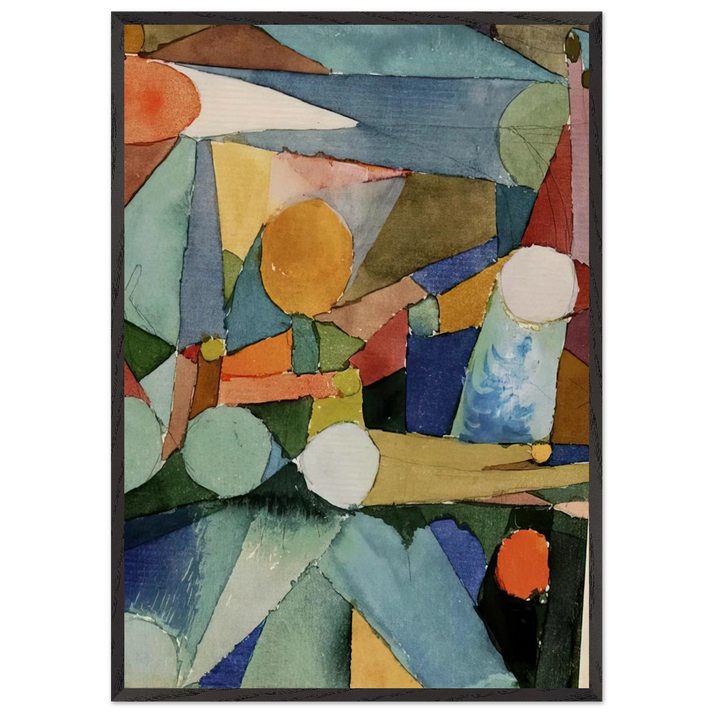
COLOUR SHAPES 1914 - Paul Klee 70x100 cm / 28x40 inches Framed Art Print – Black Wooden Frame
COLOUR SHAPES 1914 - Paul Klee 70x100 cm / 28x40 inches Framed Art Print – Black Wooden Frame
Couldn't load pickup availability
Paul Klee's "Colour Shapes" (1914) – A Masterpiece of Early Abstraction, Museum-Quality Framed Art Print
Immerse yourself in the vibrant world of Paul Klee with this exquisite museum-quality reproduction of his seminal 1914 work, "Colour Shapes". This captivating piece, presented in a generous 70x100 cm (28x40 inches) format, showcases Klee's innovative exploration of form and color that would define much of his prolific career. As a key figure in Expressionism and a teacher at the Bauhaus, Klee's unique blend of childlike wonder and profound intellectual depth is palpable in every brushstroke, or in this case, every carefully placed hue.
This fine art print is meticulously crafted to capture the essence of Klee's original vision. We utilize archival, museum-quality paper with a substantial 250 gsm (110 lb) weight and a thickness of 0.29 mm (11.4 mils). Its natural white, uncoated matte finish provides an authentic, tactile experience, allowing the rich colors and subtle textures to resonate without glare. Each print is protected by shatterproof plexiglass, ensuring both safety and clarity.
Elevate your space with an archival masterpiece that endures. The artwork is presented in a sophisticated, ready-to-hang framed presentation. Our frames are constructed from responsibly sourced oak and ash wood, featuring a robust 20mm (0.79") width that offers a more substantial and elegant profile than standard frames. The use of FSC-certified materials underscores our commitment to sustainability. This Paul Klee fine art print is more than just a decoration; it is an investment in art history, delivered ready to grace your walls.
- Artist: Paul Klee
- Artwork: Colour Shapes
- Year: 1914
- Dimensions: 70x100 cm / 28x40 inches
- Frame: Responsibly sourced oak and ash wood, 20mm (0.79") width
- Paper: 250 gsm (110 lb) matte, uncoated, natural white, archival museum-quality paper
- Protection: Shatterproof plexiglass
- Sustainability: FSC-certified materials
- Features: Ready-to-hang with included hanging kit

Discover Unlimited Art Possibilities
At RedKalion, you can find virtually any artwork from any artist, available in a wide range of sizes to perfectly match your space.
If you didn’t find what you’re looking for, contact us at support@redkalion.com . We will source any artwork and produce it in any size and format you need, including art prints, posters, canvas, framed pieces, framed canvas, and more.
For dedicated art enthusiasts, we also offer handcrafted replicas of any artwork, carefully painted by highly skilled artists using traditional techniques.
For custom requests, contact us at support@redkalion.com .
What is "Colour Shapes" by Paul Klee?
"Colour Shapes" is an iconic 1914 artwork by Paul Klee, celebrated for its pioneering use of abstract forms and vibrant color fields, characteristic of his early modernist style.
What are the dimensions of this framed art print?
This museum-quality framed art print of Paul Klee's "Colour Shapes" measures 70x100 cm (28x40 inches), offering a significant presence for your collection.
What type of paper is used for this fine art print?
The print utilizes archival, museum-quality paper: 250 gsm (110 lb) weight, 0.29 mm (11.4 mils) thick, with a natural white, uncoated matte finish for exceptional detail.
What is the frame made of and what are its dimensions?
The frame is crafted from responsibly sourced oak and ash wood, measuring a substantial 20mm (0.79") thick and wide, providing a premium finish.
Is the print protected and ready to hang?
Yes, the print is protected by shatterproof plexiglass and includes a hanging kit, making it ready to hang straight out of the package.
What is the historical significance of Paul Klee's "Colour Shapes"?
Created in 1914, "Colour Shapes" is significant as it marks Klee's definitive move towards abstraction, influencing the development of modern art and Klee's own Bauhaus teachings.
Can you tell me more about Paul Klee's artistic style in this period?
In 1914, Paul Klee was exploring vibrant color theory and geometric abstraction, moving away from representational art towards a more personal, symbolic visual language.