
RedKalion
Spinning Jenny Drawing Art Print | Industrial Revolution Fine Art Print | RedKalion
Spinning Jenny Drawing Art Print | Industrial Revolution Fine Art Print | RedKalion
Couldn't load pickup availability
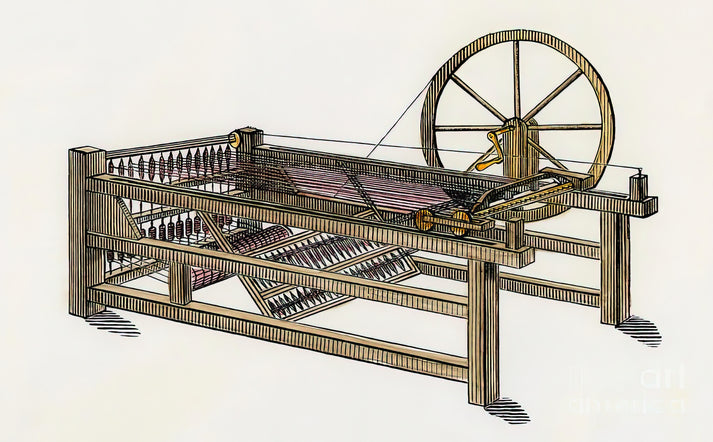
This fine art print depicts the Spinning Jenny, a pivotal invention of the Industrial Revolution. Created by James Hargreaves in the 1760s, this machine revolutionized textile production by enabling a single worker to spin multiple threads simultaneously. Our archival print captures a detailed 19th-century colour engraving, offering a window into technological history.
Historical Context of the Spinning Jenny Drawing
The Spinning Jenny emerged in Lancashire, England, during a period of rapid mechanization. Hargreaves' design, though simple, addressed a critical bottleneck in yarn production. This drawing illustrates the machine's wooden frame and multiple spindles, highlighting its functional elegance. It symbolizes the shift from cottage industry to factory-based manufacturing, a transformation that reshaped economies and societies.
Artistic Analysis of the Spinning Jenny Engraving
This 19th-century engraving employs precise linework and subdued coloration to document the invention accurately. The composition focuses on the machine's mechanics, with cross-sectional views revealing internal components. Stylistically, it blends technical illustration with artistic flair, common in scientific publications of the era. The muted palette emphasizes clarity over ornamentation, aligning with Enlightenment ideals of knowledge dissemination.
Print Specifications & Materials
- Available Sizes: 75×100 cm / 30×40″, 40×50 cm / 16×20″, 21×29.7 cm / 8×12″
- Paper Finishing: Matte, uncoated, natural white (off-white)
- Acid-Free: pH above 7 to prevent yellowing over time
- Paper Weight: 250 gsm (110 lb) | Thickness: 0.29 mm (11.4 mils)
- Sustainable Paper: FSC-certified
RedKalion presents this Spinning Jenny drawing as a premium art print, ideal for historians, educators, and design enthusiasts. Our museum-quality reproduction ensures every detail of this historical engraving is preserved, offering a timeless piece for your collection.


Discover Unlimited Art Possibilities
At RedKalion, you can find virtually any artwork from any artist, available in a wide range of sizes to perfectly match your space.
If you didn’t find what you’re looking for, contact us at support@redkalion.com . We will source any artwork and produce it in any size and format you need, including art prints, posters, canvas, framed pieces, framed canvas, and more.
For dedicated art enthusiasts, we also offer handcrafted replicas of any artwork, carefully painted by highly skilled artists using traditional techniques.
For custom requests, contact us at support@redkalion.com .
What is the Spinning Jenny drawing based on?
This art print reproduces a 19th-century colour engraving illustrating James Hargreaves' Spinning Jenny invention from the 1760s, showcasing its mechanical design during the Industrial Revolution.
What paper is used for this fine art print?
We use FSC-certified, acid-free paper with a matte finish and 250 gsm weight to ensure archival quality and prevent yellowing for your Spinning Jenny drawing print.
How is this art print shipped and packaged?
Prints are shipped flat in protective packaging to prevent damage, with tracking provided for secure delivery of your Industrial Revolution art print.
How long will this print last without fading?
With acid-free, archival materials, this Spinning Jenny drawing print resists fading and deterioration for decades under proper display conditions.
Who invented the Spinning Jenny?
James Hargreaves, an English weaver, invented the Spinning Jenny around 1764 in Lancashire, revolutionizing textile spinning during the Industrial Revolution.
What makes this engraving historically significant?
This 19th-century engraving documents a key technological innovation that increased yarn production efficiency, fueling the Industrial Revolution's growth in the textile industry.